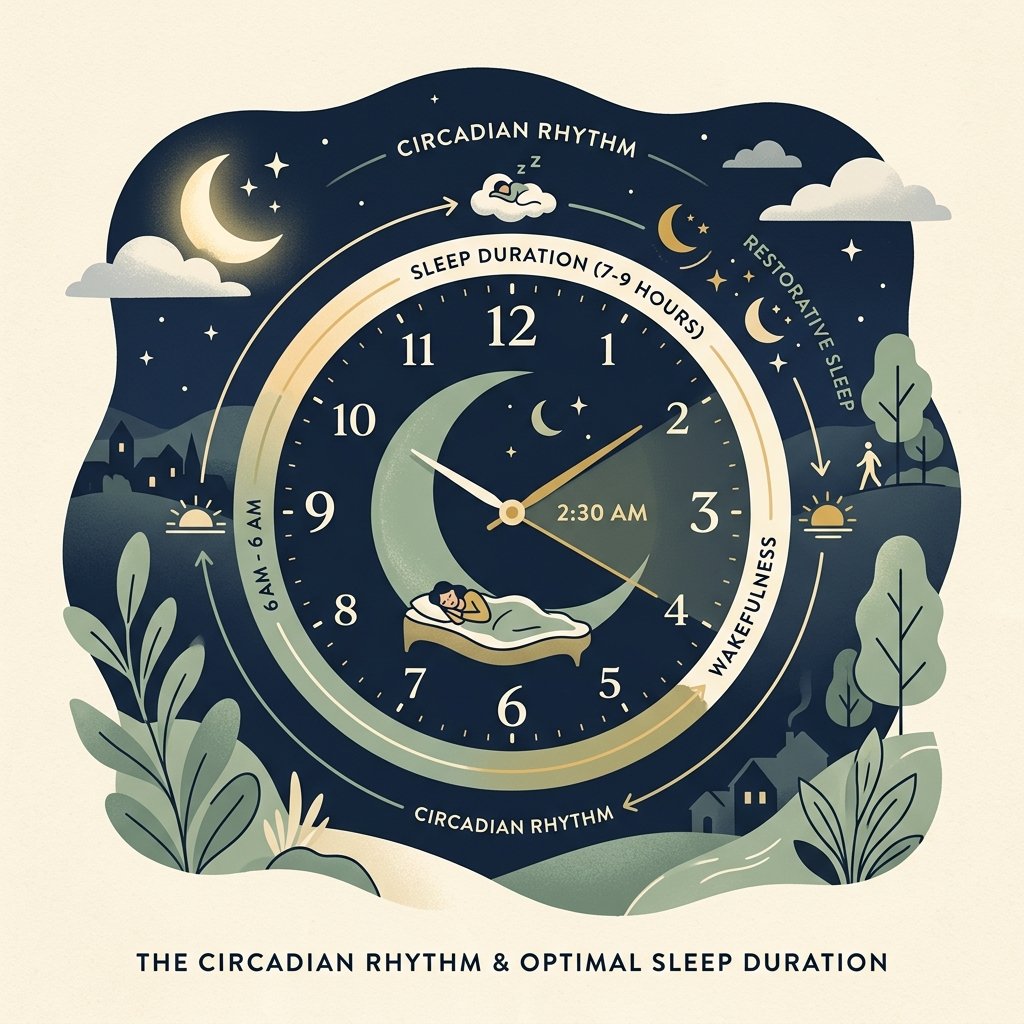
Clinical Key Takeaway: The consensus recommendation from leading medical bodies, including the National Heart, Lung, and Blood Institute (NHLBI) and the American Academy of Sleep Medicine (AASM), is that adults aged 18 to 64 need 7 to 9 hours of uninterrupted sleep per night for optimal metabolic, cardiovascular, neurocognitive, and immunological health.
1. Evidence-Based Benchmarks: Sleep Requirements Across the Lifespan
Human sleep requirements evolve substantially from infancy through advanced age, mirroring neurological development, hormonal fluctuations, and cellular turnover rates:
- Newborns & Infants (0 to 12 months): Require 12 to 16 hours per 24-hour cycle (including daytime naps) to facilitate explosive synaptic development and somatic growth.
- Toddlers & Preschoolers (1 to 5 years): Need 10 to 14 hours. Sleep in early childhood is vital for emotional regulation and foundational cognitive synthesis.
- School-Age Children (6 to 12 years): Require 9 to 12 hours of nightly sleep to support physical growth spurts, active immune maturation, and scholastic learning consolidation.
- Teenagers (13 to 18 years): Need 8 to 10 hours. During puberty, circadian biological rhythms undergo a biological phase-delay of approximately 2 hours, naturally shifting adolescents toward later sleep and wake times.
- Adults (18 to 64 years): The established medical benchmark is 7 to 9 hours nightly. Regularly obtaining fewer than 7 hours is correlated with increased all-cause mortality, cardiovascular strain, and metabolic dysfunction.
- Older Adults (65+ years): Require 7 to 8 hours. While older individuals experience architectural fragmentation, spending less time in deep Stage N3 slow-wave sleep and waking more frequently, their physiological sleep requirement does not dramatically diminish.
2. Sleep Duration vs. Sleep Efficiency: Understanding the Difference
A vital clinical metric often overlooked by individuals tracking sleep is Sleep Efficiency. Sleep efficiency is defined mathematically as:
Sleep Efficiency Formula: (Total Sleep Time ÷ Total Time in Bed) × 100 = Sleep Efficiency Percentage
A person who spends 9 hours in bed but wakes repeatedly due to environmental noise, untreated sleep apnea, or reflux may only achieve 6 hours of true sleep, yielding an efficiency of 66% (clinically considered poor). In contrast, an individual sleeping soundly for 7.5 hours out of 8 hours in bed achieves a healthy efficiency above 93%. Sleep duration must never be evaluated in isolation from sleep continuity and architectural depth.
3. The Genetic "Short Sleeper" Phenomenon vs. Adaptation
In modern high-stress culture, many individuals pride themselves on functioning on 5 to 6 hours of sleep. However, true "natural short sleepers", individuals carrying rare genetic variations (such as mutations in the DEC2 or ADRB1 genes) who can thrive on under 6 hours without neurobehavioral impairment, represent less than 1% to 3% of the human population.
Studies consistently reveal that sleep-deprived individuals adapt subjectively to chronic fatigue. Over weeks of restricted sleep, people report feeling "fine" or "used to it," yet objective neurocognitive testing reveals steadily degrading reaction times, impaired working memory, micro-sleep events, and blunted executive decision-making. In essence, sleep-deprived individuals lose the ability to accurately gauge their own level of impairment.
4. The Compounding Physiology of Sleep Debt
Sleep debt is the cumulative deficit between the amount of sleep your body biologically required and the amount it actually received over a given timeframe:
- Acute Effects (1 to 3 Nights of Deprivation): raises daytime sympathetic tone, raises circulating cortisol, disrupts leptin and ghrelin appetite hormones (triggering cravings for simple sugars and ultra-processed fats), and diminishes insulin sensitivity by up to 25% to 30%.
- Sustained Effects (Weeks to Months): Causes chronic low-grade systemic inflammation, raising C-reactive protein (CRP) and pro-inflammatory interleukins. It blunts natural killer (NK) cell activity, increasing susceptibility to respiratory viral infections.
- Cognitive Impairment Equivalency: Laboratory sleep deprivation research has demonstrated that sustained wakefulness of 17 to 19 hours produces neurocognitive performance decrements equivalent to a Blood Alcohol Concentration (BAC) of 0.05%, while 24 hours without sleep equates to a BAC of 0.10% (well over the legal driving limit).
5. Comprehensive Sleep Duration Recommendations Table
| Age Category | Recommended Duration | May Be Appropriate | Not Recommended | Primary Biological Focus |
|---|---|---|---|---|
| Newborns (0 to 3 mos) | 14 to 17 hours | 11 to 13 or 18 to 19 hrs | <11 or >19 hrs | Rapid brain growth, sensory development |
| Infants (4 to 11 mos) | 12 to 15 hours | 10 to 11 or 16 to 18 hrs | <10 or >18 hrs | Motor skill formation, immune defense |
| Children (6 to 13 yrs) | 9 to 11 hours | 7 to 8 or 12 hrs | <7 or >12 hrs | Physical growth, memory consolidation |
| Teens (14 to 17 yrs) | 8 to 10 hours | 7 or 11 hrs | <7 or >11 hrs | Pubertal hormonal maturation, mood balance |
| Adults (18 to 64 yrs) | 7 to 9 hours | 6 or 10 hrs | <6 or >10 hrs | Cellular repair, metabolic & cardiovascular health |
| Older Adults (65+ yrs) | 7 to 8 hours | 5 to 6 or 9 hrs | <5 or >9 hrs | Glymphatic neuro-cleansing, cognitive maintenance |
6. Long Sleep Duration: Can You Sleep Too Much?
While inadequate sleep is a widespread societal challenge, habitually sleeping more than 9 to 10 hours per day in adults is also statistically associated with increased health risks, including higher incidence of stroke, cardiovascular disease, and metabolic disorders.
Epidemiological research suggests that excessive sleep duration is often a symptom rather than a direct cause of illness. Underlying medical conditions associated with hypersomnia include clinical depression, chronic subclinical inflammation, chronic kidney disease, hypothyroid disorder, and fragmented sleep architecture caused by Obstructive Sleep Apnea (where a patient sleeps for 10 hours but remains exhausted due to repeated micro-suffocations).
7. Clinical Indicators Requiring Medical Assessment
If you prioritize an 8-hour sleep window every night yet continue to struggle with exhaustion, self-help lifestyle changes may not be sufficient. Consider scheduling a clinical consultation with your primary physician or a sleep specialist if you experience:
Warning Signs to Discuss with a Clinician:
- Falling asleep involuntarily during sedentary daytime activities (such as driving, meetings, or reading).
- Bed partners reporting loud, irregular snoring, pauses in breathing, or gasping sounds during the night.
- Waking up with a dry throat, morning headaches, or heart palpitations.
- Persistent inability to fall asleep within 30 minutes or waking in the middle of the night unable to return to sleep for more than 3 consecutive weeks.
- Experiencing sudden muscle weakness triggered by strong emotions (cataplexy, a sign of narcolepsy).
A diagnostic polysomnogram (in-lab sleep study) or home sleep apnea test (HSAT) can identify respiratory or neurological interruptions that rob you of genuine recovery.
8. Frequently Asked Questions
Can I train myself to need only 5 or 6 hours of sleep?
No. While you can adapt psychologically to feeling tired, cellular biological repair cannot be hurried. Data from the American Academy of Sleep Medicine indicates that chronic restriction to 6 hours or fewer diminishes glucose tolerance, immune response, and executive cognitive capacity, regardless of how accustomed you feel to low sleep.
Does a 30-minute afternoon nap help reduce my nighttime sleep requirement?
A brief 20 to 30-minute "power nap" before 2:00 PM can enhance afternoon alertness without significantly dissipating nighttime sleep pressure. However, naps do not eliminate your nocturnal requirement for complete 90-minute sleep cycles, and late-afternoon naps can interfere with falling asleep at night.
Why do older adults frequently wake up earlier in the morning?
Aging is associated with an advanced circadian sleep phase, meaning the biological clock signals drowsiness earlier in the evening and wakes earlier in the morning. age-related reductions in deep slow-wave sleep make older adults more sensitive to noise, pain, and nocturnal bathroom trips.
How do I determine my personal ideal sleep duration within the 7 to 9 hour window?
During a 1 to 2-week vacation or low-stress period, go to bed at a consistent time each night and allow yourself to wake naturally without an alarm. After paying off initial sleep debt in the first few days, observe how many hours you sleep on average before waking feeling refreshed.