Perspective: Self-care habits are not a replacement for clinical psychiatric treatment or psychotherapy when indicated. However, daily behavioral micro-habits provide the neurobiological foundation upon which mental resilience is built.
Beyond "Toxic Positivity": The Science of Micro-Habits
Popular wellness culture often reduces mental health advice to superficial slogans: "Just stay positive," "choose happiness," or take bubble baths. Clinical psychologists refer to this as toxic positivity, the overgeneralization of a happy, optimistic state that results in the denial, minimization, and invalidation of genuine human emotional suffering.
True psychological resilience does not mean ignoring sadness, grief, or anxiety. It involves developing cognitive and physiological capacity to tolerate uncomfortable emotions without becoming paralyzed by them. Behavioral science shows that the most sustainable improvements come from micro-habits: tiny, low-friction behavioral adjustments that gradually scaffold autonomic nervous system stability without triggering feelings of overwhelm.
Circadian Anchors: Light Exposure & Morning Physiology
Your mental state is directly tethered to your biological clock. In the hypothalamus, the suprachiasmatic nucleus (SCN) coordinates the timing of neurotransmitter synthesis, hormone release, and body temperature rhythms based primarily on photic input received through intrinsically photosensitive retinal ganglion cells (ipRGCs):
- Morning Natural Sunlight (10 to 20 Minutes): Viewing outdoor sunlight within 30 to 60 minutes of waking triggers an optimal Cortisol Awakening Response (CAR), providing natural alertness and setting an internal timer that facilitates melatonin release approximately 14 to 16 hours later.
- Consistent Wake Times: Waking up at the same time seven days a week (within a 30-minute variance) stabilizes mood-regulating circadian machinery far more effectively than attempting to "catch up" on sleep with erratic weekend schedules.
Somatic Nervous System Regulation: Down-shifting the Fight-or-Flight Response
You cannot always think your way out of a physiological state of high autonomic arousal. When your sympathetic nervous system is locked in fight-or-flight, heart rate variability (HRV) plummets, breathing turns shallow, and the prefrontal cortex loses executive control. Utilizing "bottom-up" somatic tools directly signals safety to the brain via the vagus nerve:
1. The Physiological Sigh
Studied extensively by neuroscientists at Stanford University, the physiological sigh consists of two consecutive nasal inhales (one deep inhale followed immediately by a sharp second inhale to fully expand collapsed alveoli) followed by a long, slow, extended mouth exhale. Performing just 3 to 5 physiological sighs rapidly slows heart rate and activates parasympathetic tone within 30 seconds.
2. Cold Water Facial Immersion
Splashing cold water on the eyes and cheeks stimulates the mammalian dive reflex via the trigeminal nerve, rapidly reducing acute tachycardia during moments of severe panic or acute emotional distress.
Movement as Neurobiological Medicine
Physical movement is one of the most potent non-pharmacological interventions for improving mood. Exercise promotes the synthesis of Brain-Derived Neurotrophic Factor (BDNF), often described as fertilizer for the brain, which supports neuroplasticity and dendritic branching in the hippocampus.
skeletal muscle contraction produces "myokines", signaling molecules that cross the blood-brain barrier to reduce neuroinflammation. You do not need punishing marathon training; brisk walking outdoors for 25 to 30 minutes daily provides substantial antidepressant and anxiolytic benefits.
Cognitive Hygiene: Untangling from Rumination Spirals
Cognitive Behavioral Therapy (CBT) demonstrates that our feelings are shaped not by external events themselves, but by our cognitive interpretations of those events. Practicing cognitive hygiene helps intercept automatic negative thoughts (ANTs):
- Identify Catastrophizing: Notice when your mind jumps immediately to the worst-case scenario. Ask yourself: "What is the most likely outcome based on objective evidence, rather than fear?"
- Cognitive Defusion: Instead of saying "I am a failure," rephrase it internally as "I am having the thought that I am a failure." This subtle linguistic shift creates psychological distance between your conscious self and transient mental chatter.
- Scheduled Worry Time: If rumination intrudes on your workday or bedtime, allocate a dedicated 15-minute "worry window" in the late afternoon. When anxious thoughts arise during the day, write them down and postpone analyzing them until your designated window.
Evidence-Based Daily Mental Health Habits Table
| Practice | Time Commitment | Target Mechanism | Daily Impact |
|---|---|---|---|
| Morning Sunlight | 10 to 15 minutes | ipRGC retinal stimulation; circadian SCN synchronization | Increases daytime alertness, enhances night melatonin timing. |
| Physiological Sigh | 1 to 2 minutes | Vagal nerve activation; pulmonary alveolar expansion | Immediately down-regulates acute anxiety and resting heart rate. |
| Brisk Outdoor Walk | 20 to 30 minutes | BDNF upregulation; bilateral visual optic flow | Lowers amygdala threat reactivity; boosts dopamine and endorphins. |
| Digital Curfew | 60 min before bed | Reduces blue-light melatonin suppression; cuts doomscrolling | Protects slow-wave sleep and REM emotional processing. |
| Genuine Social Touchpoint | 5 to 10 minutes | Oxytocin release; social safety neuroception | Buffers stress hormones and alleviates chronic loneliness. |
Boundary Architecture in Work and Personal Life
Chronic burnout is frequently driven by a lack of boundary architecture. In an era of remote work and smartphone notifications, the traditional spatial boundary between work and home has evaporated.
- Create "Shutdown Rituals": Establish a deliberate physical transition at the conclusion of your workday (closing your laptop, putting work phones away in a drawer, changing clothes, or taking a 10-minute walk) to signal to your nervous system that the threat-monitoring phase of the day has concluded.
- Practice Saying "No" Without Over-Explaining: Setting a boundary is an act of preserving energy for commitments that align with your health and core values. A polite, clear decline ("I am unable to take that on right now") does not require an exhaustive defense.
Social Connection & The Power of Co-Regulation
Human beings are obligate social mammals. Polyvagal theory emphasizes that our nervous systems are designed to co-regulate in the presence of safe, supportive others. Hearing a calm, warm voice, making soft eye contact, or sharing laughter releases oxytocin, which directly counteracts sympathetic cortisol surges.
Beware of "co-rumination", repeatedly discussing the same negative problem with a friend without moving toward problem-solving or acceptance, which can amplify shared distress. Balance venting with supportive validation and shared lighthearted activities.
Recognizing When Professional Care Is Needed
There is a profound difference between normal emotional exhaustion and clinical illness. If you experience any of the following, everyday lifestyle habits are insufficient on their own:
Signs You Should Consult a Mental Health Professional:
- Persistent sadness, emptiness, or anxiety lasting longer than two consecutive weeks.
- Inability to enjoy activities you previously loved (anhedonia).
- Significant changes in appetite, unexplained weight loss or gain, or persistent insomnia/hypersomnia.
- Difficulty performing essential tasks at work, school, or home.
- Turning to alcohol or substances to cope with emotional distress.
- Thoughts of worthlessness, self-harm, or suicide (call or text 988 immediately).
Frequently Asked Questions
What if I don't have the energy to do any of these habits?
When experiencing severe depression or burnout, even a 10-minute walk can feel impossible. Lower the bar until the friction vanishes: instead of a 20-minute walk, simply sit near an open window for 3 minutes. Focus on one micro-step. Celebrate small actions as meaningful biological wins.
Does meditation work for everyone?
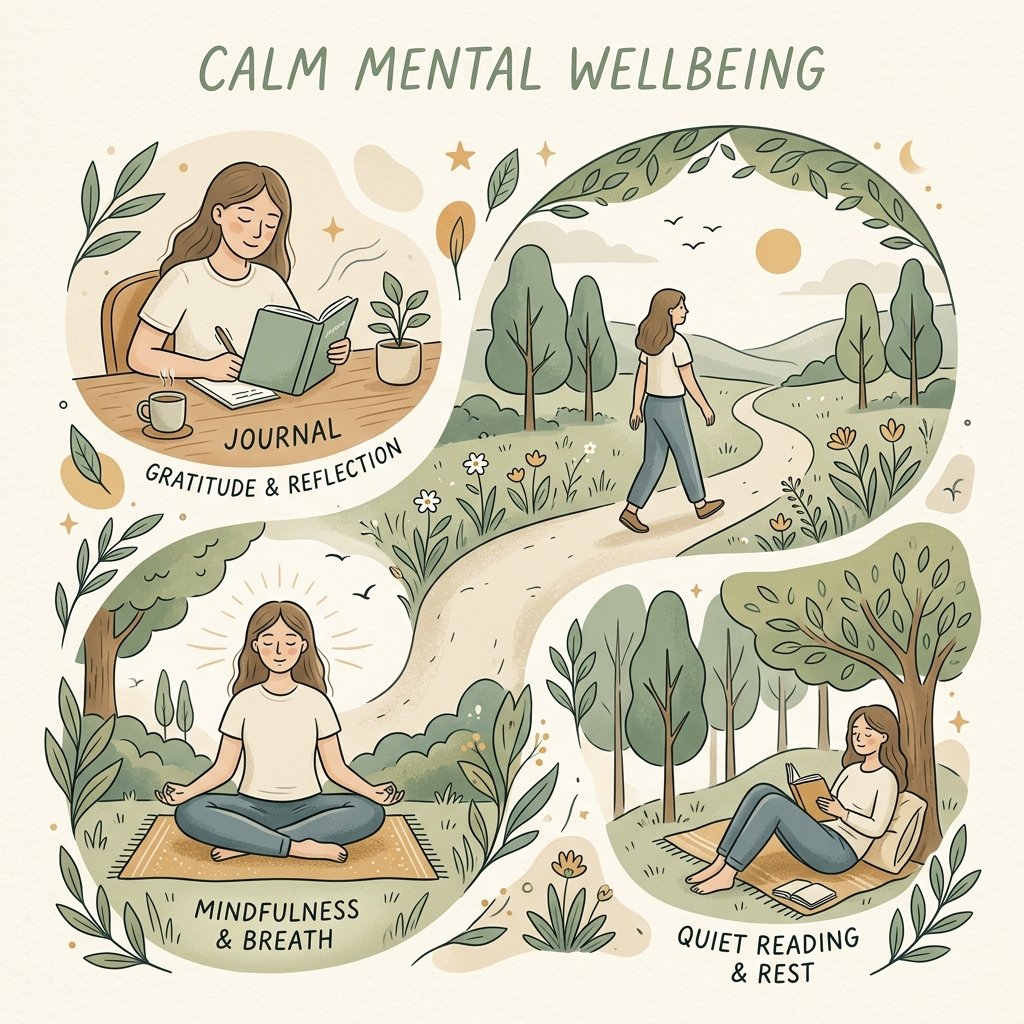
No. While mindfulness meditation has strong evidence for many individuals, sitting silently in still contemplation can trigger increased anxiety or trauma flashbacks for some. If traditional meditation causes distress, active mindfulness practices, such as walking in nature, expressive journaling, or breathwork, are equally valid ways to cultivate presence.
How long before these daily habits make a noticeable difference?
Somatic techniques like the physiological sigh produce immediate physiological calming within minutes. Circadian habits like morning light exposure and consistent sleep typically produce noticeable improvements in energy and mood within 7 to 14 days. Cumulative resilience builds steadily over months of practice.