Clinical Key Takeaway: Macronutrient tracking ("counting macros") is a nutritional budgeting method that breaks total daily caloric intake down into protein, fats, and carbohydrates. When applied flexibly, it offers structural dietary awareness; however, it is entirely optional and should never compromise your mental health or relationship with food.
1. The Three Macronutrients: Biological Roles and Energy Densities
All foods provide energy measured in dietary calories (kilocalories). These calories are delivered through three primary chemical classes of macronutrients, each playing irreplaceable structural and physiological roles:
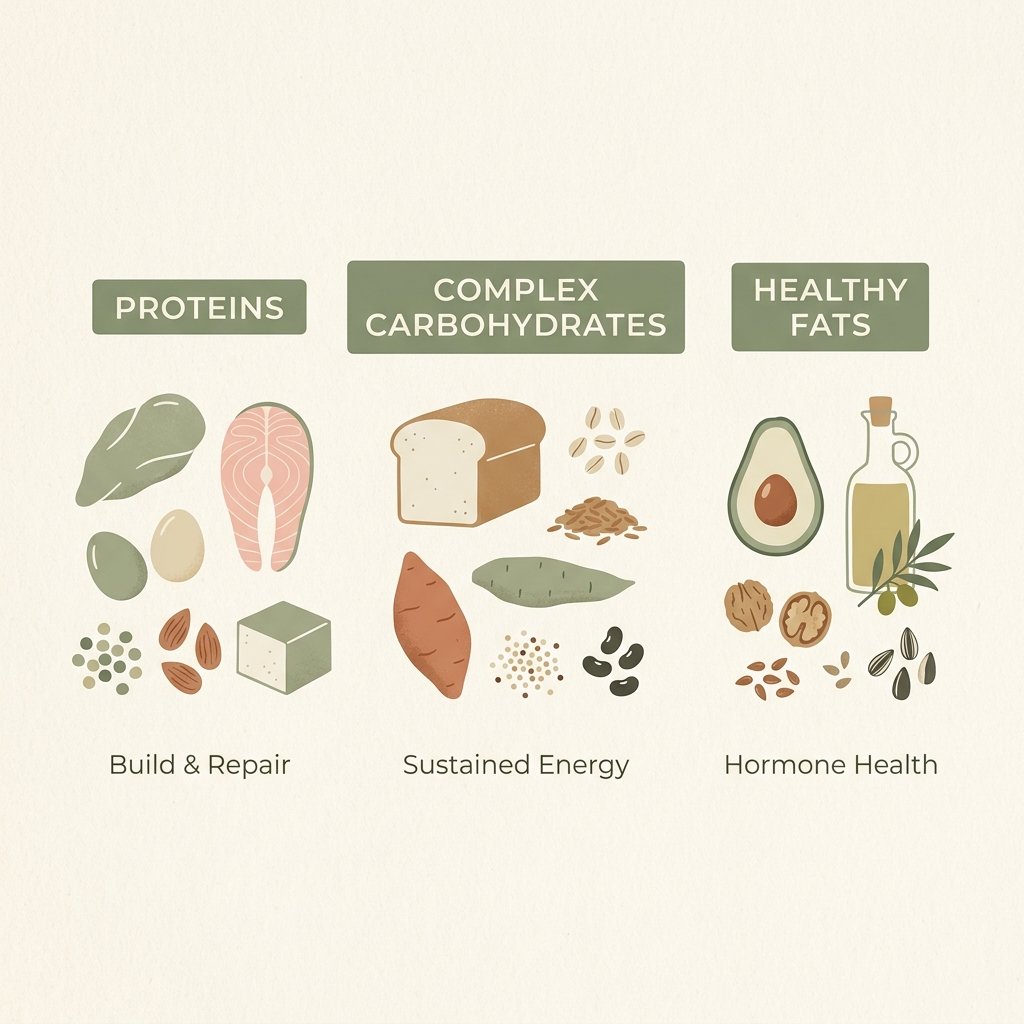
- Protein (4 calories per gram): Composed of twenty amino acids (nine of which are essential and must be obtained from food). Protein is the foundational building block for skeletal muscle, immune antibodies, peptide hormones, digestive enzymes, and connective tissue. It has the highest thermic effect of food (burning 20 to 30% of its caloric value during digestion) and promotes strong satiety signals via peptide YY and GLP-1.
- Dietary Fats (9 calories per gram): Lipids are essential for the structural integrity of cell membranes, brain myelin sheaths, the absorption of fat-soluble vitamins (A, D, E, and K), and the biosynthesis of steroid hormones (including estrogen and testosterone). Fats slow gastric emptying, contributing to sustained fullness between meals.
- Carbohydrates (4 calories per gram): The body’s preferred and most accessible fuel source for high-intensity muscular work and central nervous system cognition. Carbohydrates are broken down into glucose and stored in the liver and skeletal muscles as glycogen. Wholesome carbohydrate sources also supply dietary fibers and phytonutrients critical for gut microbiome diversity.
2. Step-by-Step: How to Calculate Your Personal Macro Targets
Calculating an evidence-based macronutrient target follows a logical, step-by-step physiological progression:
Step 1: Determine Your Maintenance Calories (TDEE)
Estimate your Basal Metabolic Rate using the Mifflin-St Jeor equation, then multiply by your physical activity multiplier (1.2 for sedentary, 1.375 for lightly active, 1.55 for moderately active). For example, a moderately active individual might have a maintenance TDEE of 2,200 calories.
Step 2: Establish a Sensible Caloric Deficit
To lose fat sustainably without triggering severe adaptive thermogenesis or muscle wasting, subtract 15% to 20% (typically 300 to 500 calories) from your maintenance expenditure. Using the 2,200-calorie example, the target deficit intake becomes 1,750 to 1,800 calories per day.
Step 3: Set Your Daily Protein Requirement
During a caloric deficit, protein intake must remain high to safeguard lean skeletal muscle mass. Clinical guidelines recommend 1.6 to 2.2 grams of protein per kilogram of total body weight (or ~1.0 g per pound of ideal body weight). For a 75 kg individual, this equals roughly 130 to 150 grams of protein daily (520 to 600 calories).
Step 4: Establish Essential Dietary Fat Floor
Fats should never be dropped excessively low, as this compromises endocrine hormonal production and lipid-soluble vitamin transport. Allocate 20% to 30% of your total target calories to healthy dietary fats. At 1,800 calories, 25% represents 450 calories, or 50 grams of fat (since fat provides 9 kcal/g).
Step 5: Fill the Remaining Caloric Budget with Carbohydrates
Subtract the calories assigned to protein and fat from your daily total. The remaining calories are allocated to carbohydrates to fuel your daily movement, workouts, and brain function. If 1,800 total kcal minus 550 kcal (protein) minus 450 kcal (fat) leaves 800 kcal, dividing by 4 kcal/g yields 200 grams of carbohydrates.
3. Practical Walkthrough: Sample Macro Budget for a 75 kg Adult
Sample Target (1,800 Daily Calories):
- Protein: 140 grams (560 kcal): 31% of total calories
- Dietary Fat: 50 grams (450 kcal): 25% of total calories
- Carbohydrates: 197 grams (790 kcal): 44% of total calories
This macro ratio provides strong muscle-sparing amino acids, protects reproductive and metabolic hormonal pathways, and leaves ample complex carbohydrates to prevent brain fog and athletic fatigue.
4. Flexible Dieting vs. Food Quality: The 80/20 Balance
In fitness communities, macro tracking is often associated with "If It Fits Your Macros" (IIFYM). The original premise of IIFYM was liberating: you do not need to restrict yourself to chicken, broccoli, and rice to lose body fat.
However, an extreme interpretation of IIFYM, attempting to hit macro numbers using ultra-processed pastries, protein bars, and fast foods, inevitably backfires. Ultra-processed foods lack dietary fiber, micronutrients, and polyphenols, leading to impaired gut microbiome diversity, rapid blood sugar crashes, and insatiable hunger.
A healthier, clinically sound approach is the 80/20 Principle: Ensure that 80% to 90% of your daily macros come from minimally processed, nutrient-dense whole foods (vegetables, fruits, legumes, whole grains, fish, eggs, poultry, nuts, seeds). The remaining 10% to 20% can accommodate cultural favorites, desserts, or social meals without guilt.
5. Macronutrient Blueprint: Roles, Targets, and Best Sources
| Macronutrient | Energy Density | Recommended Deficit Intake | Primary Physiological Roles | Optimal Whole Food Sources |
|---|---|---|---|---|
| Protein | 4 kcal / gram | 1.6 to 2.2 g/kg body weight | Muscle protein synthesis, immune antibodies, high TEF | Chicken breast, tofu, tempeh, Greek yogurt, salmon, lentils, eggs |
| Dietary Fat | 9 kcal / gram | 20 to 30% of total calories | Steroid hormone synthesis, lipid vitamins, cellular membranes | Extra virgin olive oil, avocados, walnuts, chia seeds, wild mackerel |
| Carbohydrate | 4 kcal / gram | Remainder of caloric allowance | Glycogen replenishment, high-intensity exercise fuel, prebiotic fiber | Oats, quinoa, sweet potatoes, blueberries, black beans, apples |
6. The Visual Alternative: Hand-Portion Sizing Without Scales
Weighing food on digital gram scales and scanning barcodes into mobile applications can feel tedious and socially restrictive. For most individuals seeking sustainable health, the Hand-Portion Sizing Framework provides an excellent visual estimation method:
- Palm of Your Hand = 1 Serving of Protein: Approximately 20 to 30 grams of protein (e.g., chicken breast, fish fillet, tofu slice, or two eggs).
- Fist = 1 Serving of Non-Starchy Vegetables: Packed with micronutrients, water, and fiber with negligible caloric burden (e.g., broccoli, spinach, peppers).
- Cupped Hand = 1 Serving of Dense Carbohydrates: Approximately 25 to 35 grams of carbs (e.g., cooked brown rice, oatmeal, beans, sweet potato, or berries).
- Entire Thumb = 1 Serving of Healthy Fats: Approximately 7 to 12 grams of dietary fat (e.g., olive oil, peanut butter, raw almonds, or seeds).
For most adults, starting with 1 to 2 palms of protein, 1 to 2 fists of vegetables, 1 to 2 cupped hands of carbs, and 1 thumb of fats at main meals provides balanced macronutrient distribution without touching a scale.
7. Psychological Red Flags: When to Stop Tracking
Food tracking is merely a pedagogical tool to understand portion sizes and energy density. In susceptible individuals, daily weighing of food can morph into obsessive patterns and disordered eating behaviors. Monitor yourself for the following signs:
Signs You Should Discontinue Food Tracking:
- Experiencing intense guilt, anxiety, or panic when eating foods of unknown caloric or macronutrient composition.
- Refusing to attend social gatherings, dinners with family, or restaurants due to inability to measure ingredients.
- Compensating for going over macro targets by engaging in punitive fasting or excessive exercise purge routines.
- Viewing food items strictly as mathematical numbers rather than sources of nourishment, enjoyment, and culture.
If you recognize these behaviors, pause tracking immediately and consult a registered dietitian or licensed mental health professional specializing in eating psychology.
8. Frequently Asked Questions
Do I have to track macros forever to keep weight off?
No. Tracking is best utilized as a short-term educational tool lasting 4 to 12 weeks. It teaches you how much protein, fiber, and energy different foods actually contain. Once you internalize standard portion sizes, transitioning to simple eating or hand portions is ideal for long-term psychological sustainability.
Does dietary fat make you fat?
No. Dietary fat is an essential nutrient required for life. Consuming dietary fat in caloric balance does not cause adipose gain. However, because fat is calorically dense (9 kcal/g compared to 4 kcal/g for protein and carbs), small serving sizes carry substantial calories, making portion awareness important.
Should I subtract dietary fiber from total carbohydrates (net carbs)?
In general, insoluble dietary fiber passes through the gastrointestinal tract unabsorbed, providing negligible caloric value. Soluble fibers are partially fermented by colonic bacteria into short-chain fatty acids yielding approximately 1.5 to 2 kcal/g. Focusing on total wholesome carbohydrates with at least 28 to 35g of fiber is generally simpler and more beneficial than obsessing over net carb math.
What should I do if I exceed my macro target for a single day?
Do nothing punitive. One day of overeating cannot cause meaningful adipose gain, just as one day of clean eating cannot resolve chronic health issues. Avoid skipping meals the next day. Simply return to your regular, balanced routine at your next meal.